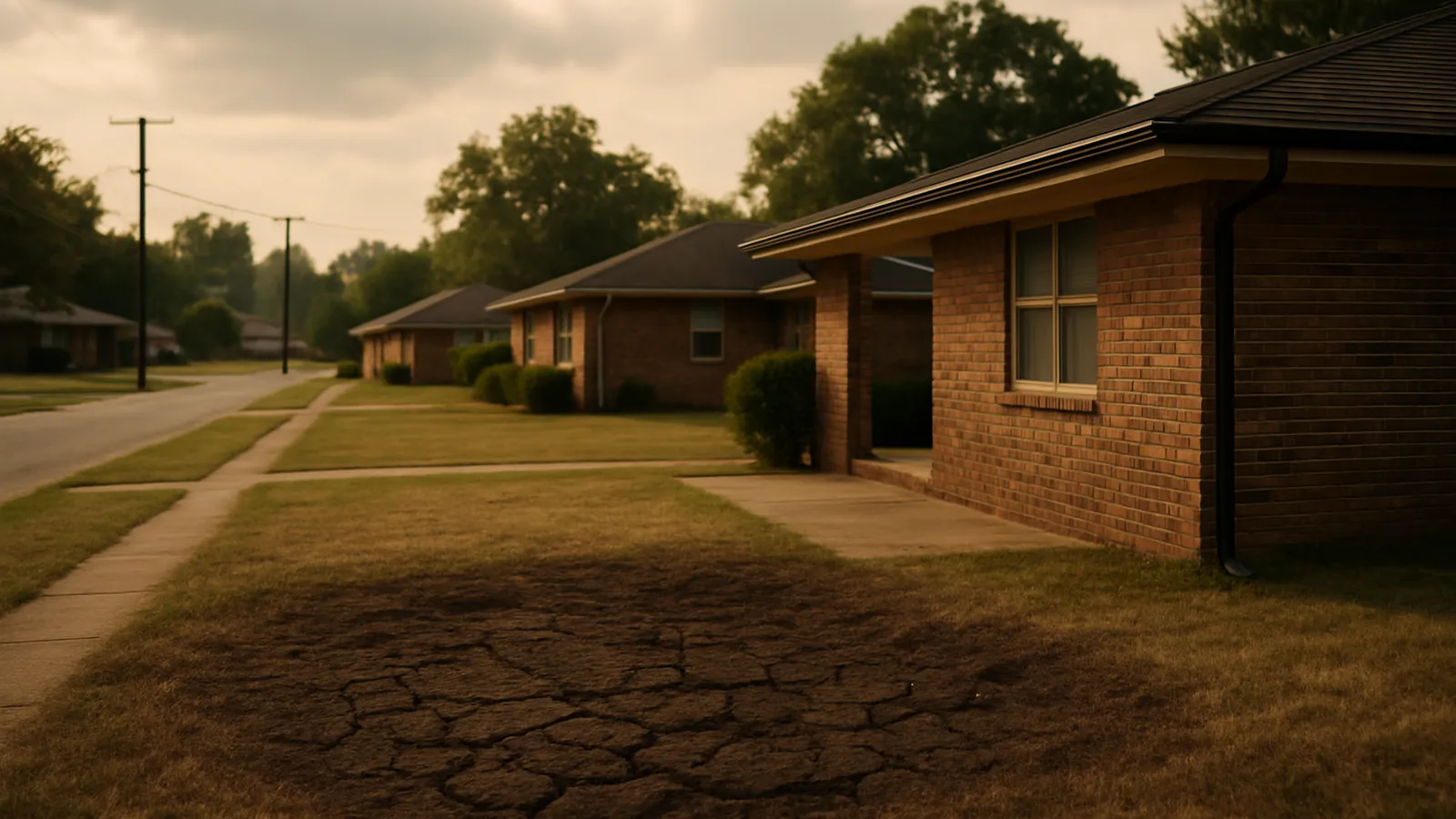
Foundation piering in Tyler runs $4,000–$15,000 for most full repairs, with piers commonly $1,200–$3,000 each. Depth is driven to refusal or tested capacity below the active Wilcox clay zone, because that clay changes volume 15–30% between wet and dry.
Why piers are the permanent answer on this soil, how depth is decided, and what the warranty is worth.
What is actually under a Tyler house
Smith County sits on the Wilcox Group — the red and orange East Texas clays interbedded with Taylor Marl that soil scientists classify as Vertisols. They rank among the highest on the national shrink-swell index, changing roughly 15 to 30 percent in volume between saturated and bone dry. That is not a subtle number. A slab sitting on soil that expands a quarter of its volume in spring and contracts back through an East Texas August is sitting on something closer to a slow tide than a foundation.
The damage almost always happens on the dry half. Wet clay pushes evenly and mostly lifts; drought pulls the clay away from the slab perimeter, leaving voids the concrete has no choice but to settle into. That is why so many Tyler homeowners first notice cracks in late summer, and why the phone rings hardest after a dry July.
How the pier design gets decided
| Step | What it produces | Why it matters |
|---|---|---|
| Elevation survey | A floor-level map in numbers | Pier count and placement come from this, not from crack photos |
| Exterior water reading | Where roof and lot water goes | Piering without drainage treats half the problem |
| Depth to stable bearing | Refusal depth or tested capacity | Must clear the active zone where clay still moves seasonally |
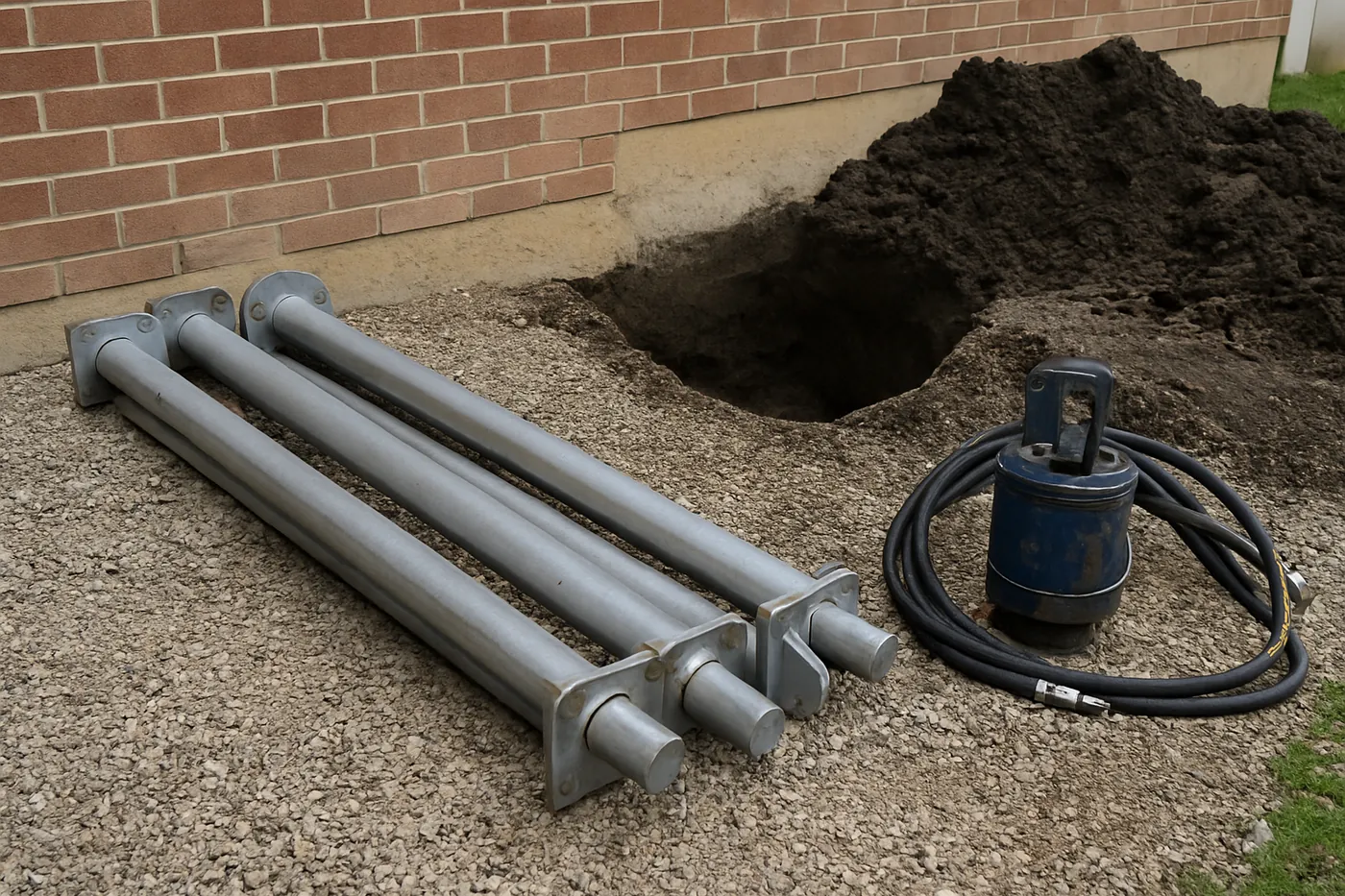
| Pier type selection | Push vs. helical by load | House weight decides which one can be installed properly |
| Lift target | How much elevation to recover | Stabilize first; lift only as far as finishes tolerate |
Where piering fits in a foundation repair scope
Piers are the structural half. The complete scope on this soil pairs them with the water work that stops the cycle — corrected grade, extended downspouts, even perimeter moisture through drought. We price both halves in the same document so the number you see is the number that actually solves the problem. Where the survey reads near flat, the scope is drainage alone and we say so.
What the install looks like at your house
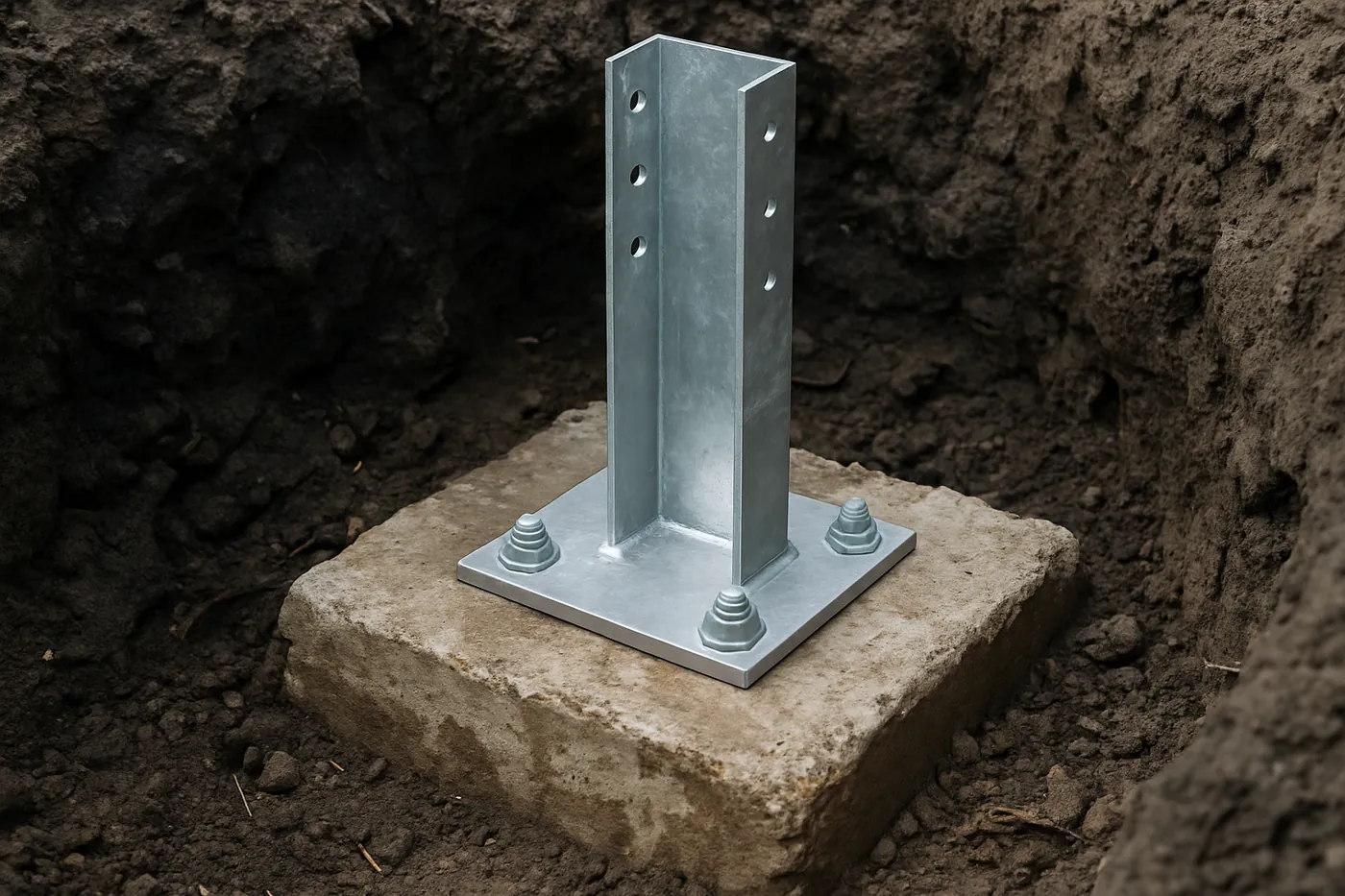
Most residential pier jobs run two to five days and nearly everyone stays home through it. Expect excavation at the footings, equipment in the yard, and noise during working hours. Interior disruption is limited unless interior piers are in the scope. Each pier is driven, load-tested, and logged — and that log is the document behind the warranty. A pier job with no depth or torque record is a promise with nothing standing behind it.
The first year after the piers
Piers stop the movement; they do not erase its history. Give the house one full East Texas cycle — a wet spring and a dry August — before chasing cosmetics, and you patch drywall and re-point brick once instead of twice. Monitor for free in the meantime: a dated photo and a pencil line drawn across each crack answers “did it move?” in ten seconds. And keep watering the perimeter through the drought months. Soaker hoses are not a repair, but on clay that shrinks this hard they keep the unpiered parts of the house from writing you a new problem. Every price is in the cost guide.
Piering questions, straight answers
What does foundation piering cost in Tyler?
Most full repairs run $4,000-$15,000, with individual piers commonly $1,200-$3,000 each depending on depth and type. Pier count is what drives the number, and pier count comes from the elevation survey - not from a walk-around. The evaluation with measurements is free.
How deep do piers have to go here?
Past the active zone - the depth where Wilcox clay still swells and shrinks with the seasons. That depth varies across Smith County, which is why we drive to refusal or to a load-tested capacity rather than to a fixed number. A contractor quoting a standard depth before measuring is quoting a price, not designing a repair.
Push piers or helical piers?
Push piers use the weight of the house to drive resistance piers to load-bearing strata and suit heavy masonry homes. Helicals screw in and carry a measured torque, which makes them right for lighter structures, porches, and additions where there is not enough house weight to drive a push pier. Most Tyler homes get push piers; the survey decides.
Will piering close my cracks?
Some, partially, and that is the honest answer. Lifting recovers elevation, and cracks frequently narrow as the structure returns toward level - but the goal is stabilization, not cosmetic perfection. Chasing full closure means lifting hard enough to crack finishes elsewhere. Cosmetic repair comes after a full seasonal cycle.
Is there a warranty?
On our pier work, yes, and you should read it before the price. It covers the piered section holding its design load - not the whole house and not sections nobody piered. Ask whether it transfers to the next owner, what a transfer costs, and whether it survives the contractor closing its doors.
Get a free Tyler foundation evaluation
Tell us what the house is doing — stair-step cracks in the brick, doors that stick every August, sloping floors, separating trim — and we’ll schedule an evaluation with photos and measurements. We reply the same business day.