Foundation repair in Tyler usually lands at $4,000–$15,000 for a full repair. Slab jobs run $3,500–$12,000, each pier $1,200–$3,000, drainage fixes $1,500–$6,000, and crack repair $400–$1,500. Which of those your Smith County house needs is decided by the floor elevation survey, not by the look of the cracks.
What you get in each price band, what pushes it higher or lower, and how to weigh two bids that disagree.
Tyler foundation prices by job
| Job | Typical range | What it covers |
|---|---|---|
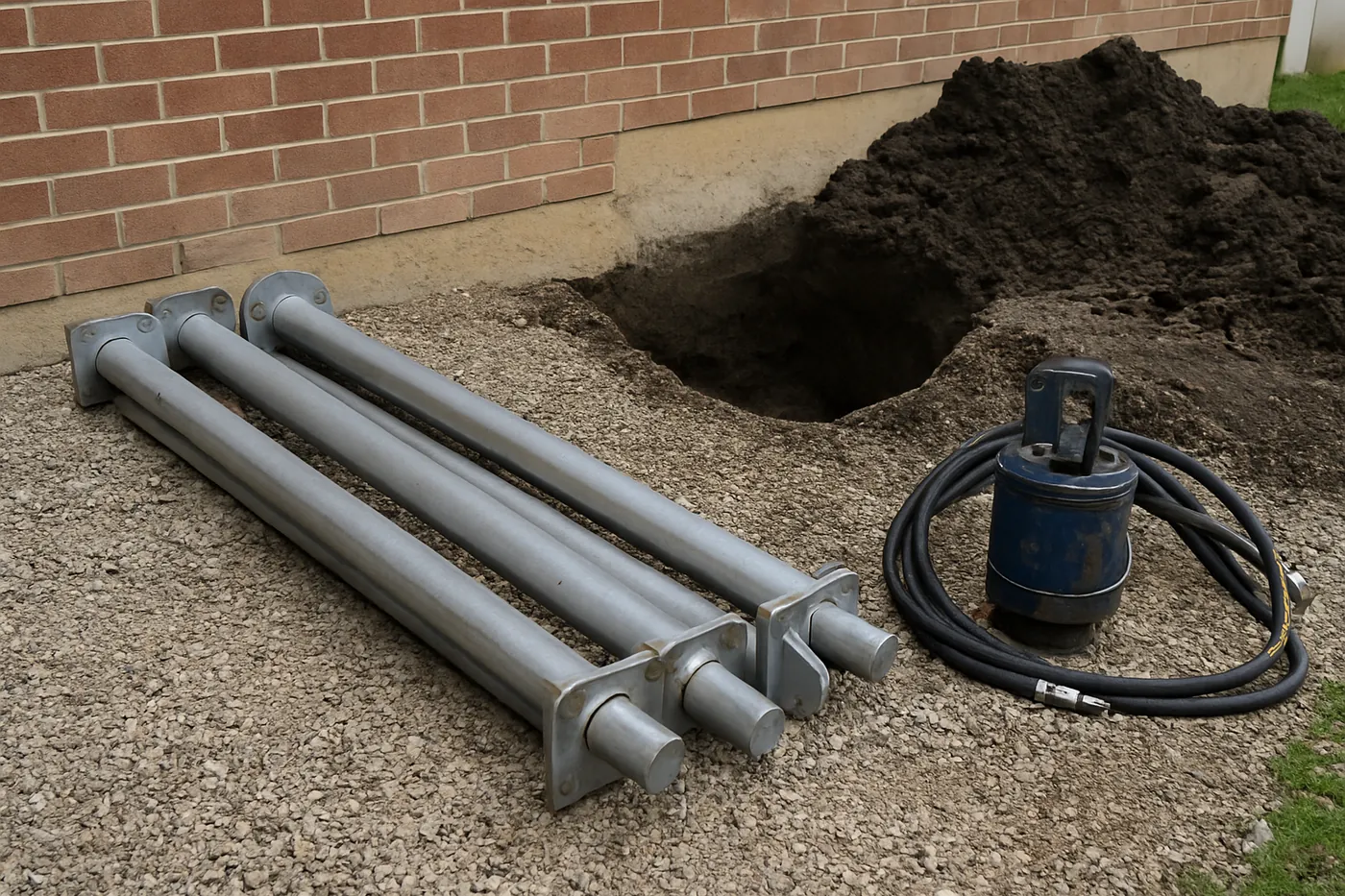
| Full repair with piering | $4,000–$15,000 | Piers placed where the elevation survey says, pushed until they stop or reach tested load, the slab raised to a set target, and a record kept for every pier |
| Individual piers | $1,200–$3,000 each | Pushed steel or helical, chosen by how heavy the house is and how easy it is to reach |
| Slab repair | $3,500–$12,000 | Support at the edge and inside, raising the slab, and a plumbing test when only one area moved |
| Drainage correction | $1,500–$6,000 | Regrading, longer downspouts, French drains and area drains; often all a house needs |
| Crack repair | $400–$1,500 | Injected epoxy or polyurethane, sealing, and brick mortar repointed once movement has stopped |
| Concrete leveling | $500–$2,500 | Foam lifting of driveways, patios, sidewalks, and porch slabs |
| Elevation survey & evaluation | Often free | Floor heights as numbers, cracks recorded, the drainage path checked, and a written scope |
The measurement that sets the price
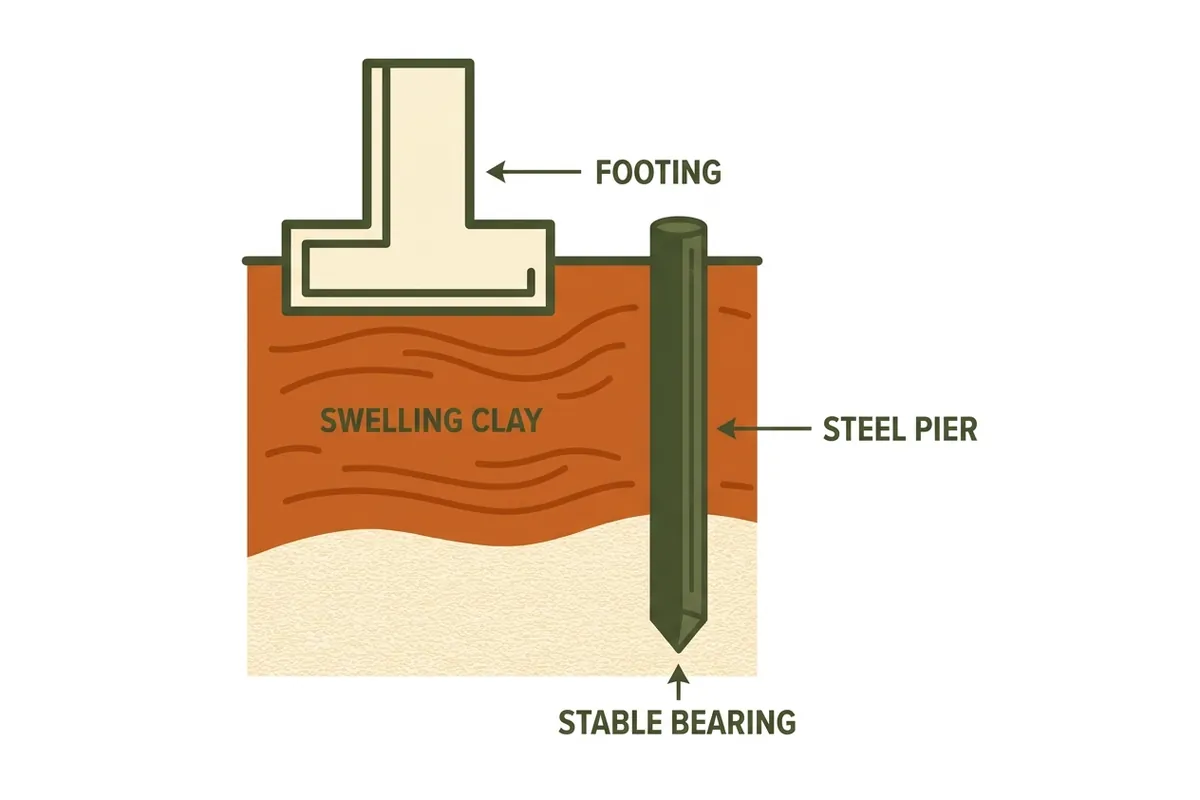
Pier count is the number that moves a Tyler estimate, and pier count comes from an elevation survey: a grid of floor-height readings reported in inches. Everything else is interpretation. A house reading a quarter inch out across its span does not need piers no matter how dramatic the brick cracking looks; a house reading an inch and a half low at one corner needs a defined number of them in a defined place. When two bids differ by thousands, the difference is almost always that they assumed different counts, or that one of them never measured.
What raises or lowers a Tyler estimate
| Factor | Effect | Why |
|---|---|---|
| Piers needed inside the house | Up a lot | Flooring has to come up and go back down |
| Deep refusal on your lot | Up | More pier sections per location; depth varies across Smith County |
| A plumbing leak turns up | Up, though insurance may help | The leak repair adds cost but can make a claim payable |
| Room for equipment | Up when it is cramped | Digging by hand and with small machines is slower |
| Floors measure almost level | Down, sharply | Drainage work and watching it, not structural repair |
| Found early, in one area | Down | Fewer piers, less raising, and no drywall or trim to fix |
Where the honest cheap answer lives
Plenty of Tyler houses never need a pier. What they need is control of the water: gutters added where the roof has none, downspouts run well out beyond the clay that swells, the first ten feet of yard sloped away again, and steady soil moisture around the slab through the dry East Texas summers. That costs $1,500–$6,000 at the most and often just a few hundred dollars, and when movement is caught early it breaks the wet and dry cycle that would otherwise lead to a five-figure repair within ten years. An honest specialist will write that smaller scope, since the other path leaves a homeowner learning the truth later.
Spreading the work out when the total is too high
If money is the limit, this order keeps you safe: fix the drainage, then stabilize the area that has moved most, then the remaining sections, and cosmetic repairs at the very end. Done in that order, no stage has to be repeated. The one thing a staged plan must not put off is the drainage, because on East Texas clay it controls how fast the sections not yet repaired keep shifting. Ask for the scope in stages with a written price for each stage before work starts.
Cost questions, straight answers
What's the average foundation repair cost in Tyler?
An average would mislead you, since the kinds of job hardly overlap. Drainage-only fixes are $1,500-$6,000, crack repair $400-$1,500, concrete leveling $500-$2,500, slab work $3,500-$12,000, and full pier repairs $4,000-$15,000. The elevation survey, not how scary the cracks look, tells you which applies.
Why do two Tyler bids differ by thousands?
Usually pier count, and pier count should come from a survey. A bid built on twelve piers and a bid built on twenty are not the same job, and neither is comparable to a bid that never measured floor elevations. Ask each company for the survey numbers behind the count - a company that cannot produce them is quoting rather than designing.
Is the cheapest bid ever the right one?
Sometimes. On early movement with a near-flat survey, correcting drainage for $2,000 genuinely is the whole answer, and a $12,000 pier quote for that house is overselling. The test is whether the low bid addressed the water and the numbers, or simply skipped them.
Does insurance pay for any of it?
Seldom when the soil moved, because Texas homeowners policies exclude earth movement, and swelling and shrinking clay counts as that. Often when a sudden plumbing leak under the slab did the damage, a frequent cause around Tyler. That difference makes a static plumbing test worth doing before you spend money on repairs.
Can the work be phased?
Yes, it can be split up, and on Smith County clay the order matters: drainage first, the worst-moving section second, then the rest, and cosmetic work last. In that order nothing needs doing twice; reversed, you pay twice. Ask for a staged scope with a written price on each stage.
Is there a charge for the evaluation?
Many local specialists don't charge for the first visit, but it depends on the company, so ask when the specialist calls. Expect the visit to include an elevation survey, a record of the cracks, and a look at drainage outside, and some visits end with 'lengthen two downspouts and regrade the north side.' Before you sign, ask for each line priced in writing.
Get a Tyler foundation evaluation
Tell us what the house is doing (stair-step cracks in the brick, doors that stick every August, sloping floors, separating trim) so the evaluation starts from what you have seen. A local specialist who works in Tyler will call you back.