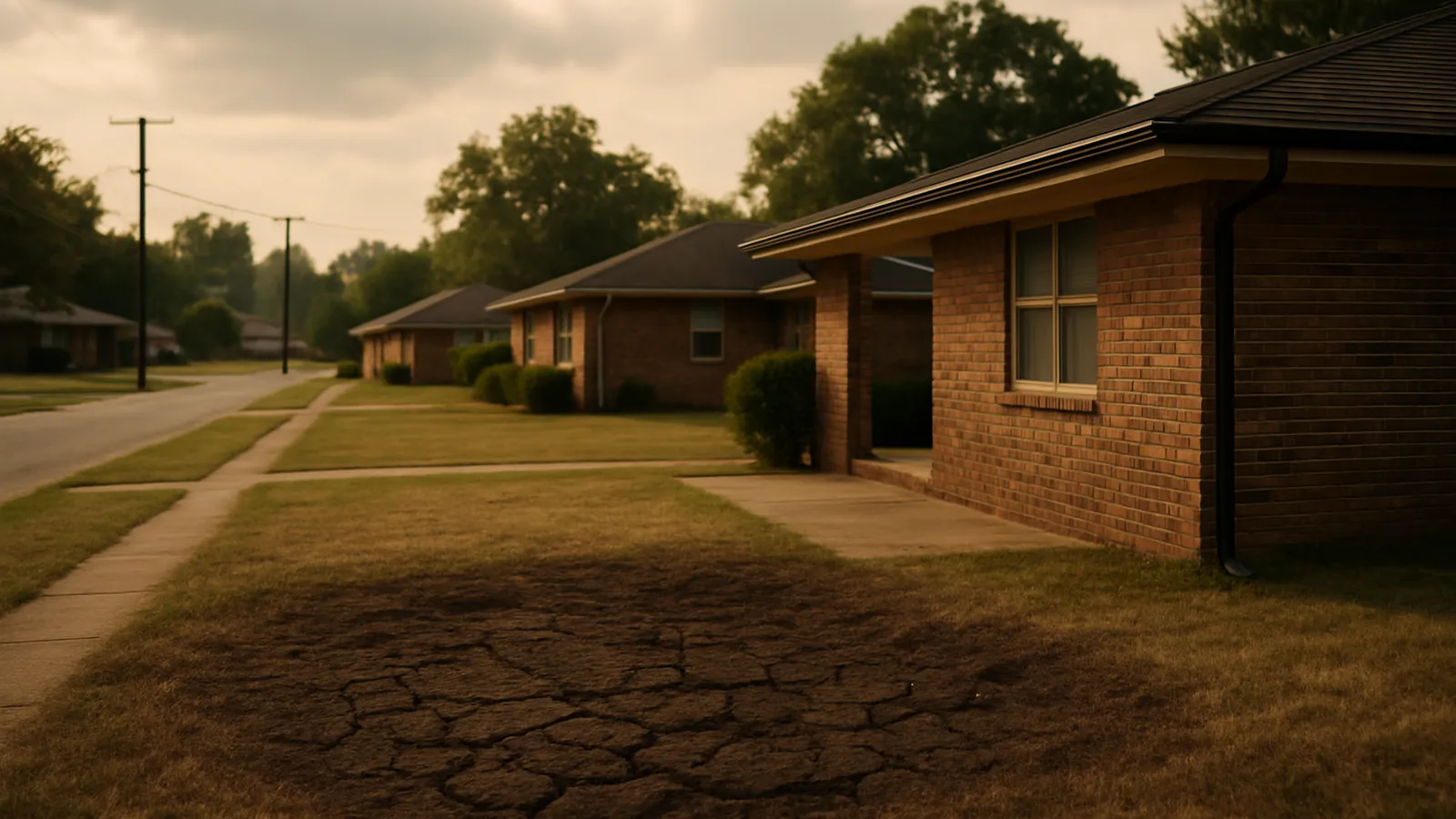
Homeowners insurance rarely covers Tyler foundation repair caused by soil movement — the earth-movement exclusion covers expansive-clay settlement. It frequently does cover damage from a sudden plumbing discharge under the slab. Out of pocket runs $4,000–$15,000.
The exclusion in plain language, the exception worth chasing, and the file that decides it.
The exclusion, plainly
Open almost any Texas homeowners policy and you will find earth movement listed among the excluded perils — earthquake, landslide, subsidence, and the expansion or contraction of soil. Wilcox clay swelling in spring and shrinking in August is, in the policy’s language, precisely that. So the honest expectation for the typical Tyler settlement claim is denial, and a contractor who tells you otherwise to close a sale is doing you harm. That is the general rule. The exception is where the real money is.
The exception worth chasing
If water escaping a plumbing line under your slab saturated the clay and caused it to move, the cause of loss is a sudden discharge rather than earth movement — and many policies cover the resulting damage even while excluding the cost of fixing the pipe itself. In a market where slab-on-grade dominates and supply lines run under concrete, this is not a rare scenario. It is also why we recommend a static plumbing test before piering a house with localized movement: it either finds a covered cause or rules one out, and both outcomes are worth knowing before you spend.
Covered or excluded — the usual verdicts
| What happened | Typical outcome | What decides it |
|---|---|---|
| Slab settled through seasonal clay cycling | Excluded | Earth movement exclusion |
| Supply line burst under the slab | Often covered | Sudden and accidental discharge |
| Sewer line leaking for months | Contested | Whether “sudden” survives the evidence |
| Drought cracked the slab | Excluded | Soil contraction |
| Plumbing leak found during repair | Worth filing | Causation letter and timeline |
| Cosmetic cracks, no measured movement | No claim to make | No covered damage |
Build the file before you call anyone
Claims are decided on evidence with a short shelf life, because the first instinct is to clean up and repair. Before that: photograph the water, the damage, and the failed component from several angles. Keep the failed section of pipe — it is the most persuasive object in a disputed claim. Get the plumber’s written report naming the line and the failure. Record the date you discovered it and what you did that day, because carriers expect mitigation and will reduce a claim you let sit. Our elevation survey documents the movement in numbers, which is the other half of the causation story.
If the denial letter comes back
A denial is a position, not a verdict. Ask the carrier in writing for the exact policy language it relied on, because “earth movement” cited against a plumbing-discharge claim is the single most reversible mistake adjusters make. What reverses it is a stamped engineer’s causation letter naming the covered peril — water escaping a line — and tying it to the damage, ideally with the leak located and documented before repairs bury the evidence. If the carrier still will not engage, the Texas Department of Insurance takes consumer complaints and carriers answer them. Watch your policy’s suit-limitation clause the entire time: on these claims it is frequently the deadline, not the merits, that ends the argument. Pricing without insurance is in the cost guide.
Insurance questions, straight answers
Does homeowners insurance cover foundation repair in Texas?
Usually not when the cause is soil movement. Standard policies exclude earth movement, and settlement from expansive clay cycling is exactly that. The live exception is damage caused by a sudden covered discharge - a burst supply line or sewer leak under the slab - which is a genuinely common cause in Tyler and worth pursuing.
My slab leak caused the movement. Now what?
Document aggressively and file. Photograph the leak location and the damage, keep the plumber's report identifying the failed line, and get the repair sequence written down. Many policies cover the resulting damage even when they exclude the pipe repair itself, and the causation letter is what carries the claim.
What is the earth-movement exclusion exactly?
Language in nearly every homeowners policy excluding loss caused by earthquake, landslide, subsidence, and the expansion or contraction of soils. It is why a house that settled through ordinary Wilcox clay cycling is a maintenance expense rather than a covered loss, however unfair that feels.
Will filing raise my premium or risk non-renewal?
Worth asking your agent before you file. Carriers weigh claim history at renewal, and a denied claim still records as a claim. That argues for filing when the cause is genuinely a covered peril with documentation behind it, and against filing hopefully when the exclusion plainly applies.
What does it cost when insurance says no?
Most full repairs run $4,000-$15,000, piers $1,200-$3,000 each, slab work $3,500-$12,000. We write scopes that can be phased where budget requires - correct the water first, stabilize the worst zone next, finish later - because on this clay the drainage half protects everything else.
Get a free Tyler foundation evaluation
Tell us what the house is doing — stair-step cracks in the brick, doors that stick every August, sloping floors, separating trim — and we’ll schedule an evaluation with photos and measurements. We reply the same business day.